How IT Company AI Services Turn Business Operations Into Automated Workflows?
Every growing business hits a wall at some point. Leads pile up. Support tickets go unanswered. Invoices sit in a queue. Teams spend half their day doing work that a machine could handle in seconds.
This is exactly where IT company AI services step in.
Modern IT companies no longer build software. They design intelligent systems that study your business, learn from your data, and automate the tasks that drain your team's time. The result? Your people focus on decisions that matter, while AI handles the rest.
What IT Company AI Services Actually Do for a Business
When people hear "AI," they often picture science fiction. The reality is far more practical.
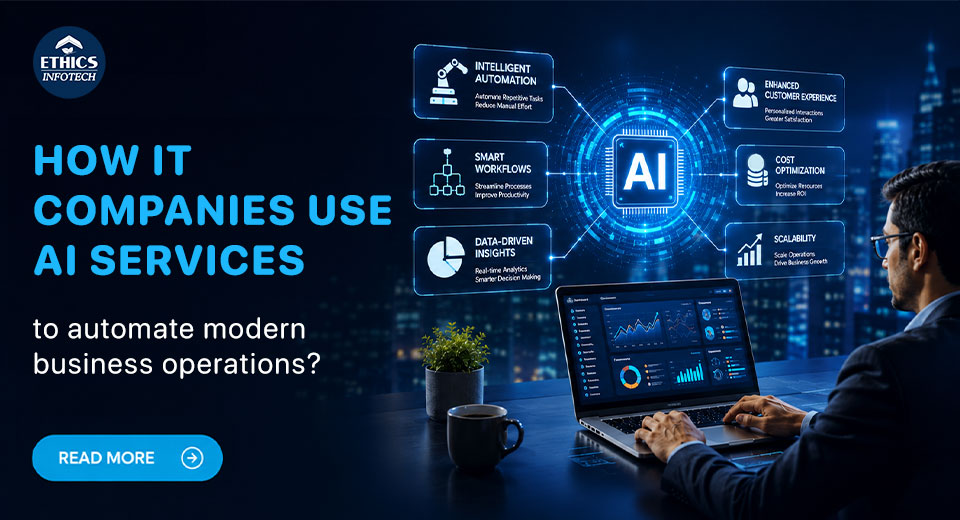
IT company AI services deliver tools built around your specific workflows. These include process automation, predictive analytics, intelligent customer support, document handling, and data-driven reporting. Each solution works within your existing systems, not as a replacement for your team, but as an extension of it.
A well-built AI system can scan thousands of records in the time it takes a human to open a spreadsheet. It can answer a customer query at 2 AM, flag an unusual financial transaction, or tell your sales team which leads are most likely to convert, all without a single manual step.
Why Small Businesses Need Artificial Intelligence Too
One common belief is that artificial intelligence for small businesses is out of reach, too expensive, too complex, or only useful at scale. That is no longer true.
Cloud-based AI tools have completely changed the economics. A small logistics company can now use AI to optimize delivery routes. A boutique accounting firm can automate invoice processing. A startup can deploy an AI chatbot that handles 80% of customer questions without hiring additional staff.
According to a study referenced by Entrepreneur.com, nearly 68% of small businesses have already deployed some form of AI to manage daily operations. The businesses seeing results are not necessarily the largest. They are the ones that identified the right problems to solve and matched them with the right tools.
The key for small businesses is to start focused. Pick one area where time is being lost, or errors are frequent. Let AI address that specific gap first. Once you see the return, expand from there.
What Makes AI Implementation for Companies Actually Work
Deploying AI is not the challenge most businesses expect. The real challenge is deploying it with intention.
Successful AI implementation for companies follows a clear sequence:
Understand the problem before choosing the tool. AI tools are not one-size-fits-all. A company struggling with customer response times needs a different solution than one dealing with inaccurate demand forecasting. Define the problem in plain business terms before evaluating any technology.
Work with clean, organized data. AI systems learn from data. If your data is scattered, duplicated, or outdated, no tool will perform well. A good IT partner will audit your data before building anything on top of it.
Integrate rather than replace. The most effective AI implementations connect with existing CRM, ERP, or communication platforms. This reduces friction for your team and speeds up adoption.
Measure from day one. Every AI deployment should have a clear metric attached, such as response time, error rate, lead conversion, or cost per ticket. Without measurement, you cannot improve.
Train your team properly. Technology only delivers value when the people using it understand it. Employees who trust the tool and know how to act on its outputs are the difference between a project that stalls and one that scales.
Core Areas Where AI Services Drive Results
Customer Support Automation
AI-powered chatbots and virtual assistants handle routine queries around the clock. Customers get instant responses. Support teams handle fewer repetitive tickets. Businesses using AI in customer support have reported cost reductions of up to 30% per support operation, according to IBM's Global AI Adoption Index.
Sales and Lead Intelligence
AI tools analyze buying behavior, engagement history, and market signals to rank leads by conversion potential. Sales teams spend less time chasing cold contacts and more time closing warm ones. Predictive models also help forecast pipeline revenue with far greater accuracy than manual methods.
Process and Document Automation
Data entry, invoice matching, contract review, compliance checks. These tasks consume significant time across industries. AI handles them faster and with fewer errors, freeing up teams for higher-value work.
Inventory and Supply Chain Optimization
For product businesses, AI predicts demand based on historical data, seasonal patterns, and external factors. This reduces both overstock and stockouts, directly improving margins.
Marketing Personalization
AI analyzes customer behavior to build targeted campaigns that speak to individual interests rather than broad segments. Personalized marketing consistently outperforms generic outreach in conversion rates and engagement.
Choosing the Right IT Partner for AI Services
Not every IT company delivers the same results. Before committing to a partner, ask these questions:
-
Do they customize solutions to your business or sell packaged tools with minimal adjustment?
-
Can they show you previous implementations with measurable outcomes?
-
Do they offer support after deployment, or hand over the keys and walk away?
-
Do they address data privacy and compliance from the start?
A strong IT partner treats AI implementation as a long-term collaboration, not a one-time project. They help you scale as your needs evolve.
The Real Advantage: Increasing Efficiency Over Time
One underestimated benefit of AI is that it improves as it runs. The more data a system processes, the more accurate its predictions become. The more interactions a chatbot handles, the better it understands your customers.
This means the businesses that implement AI today will have a measurable data and efficiency advantage over those that wait. The gap between early adopters and late movers grows wider with every passing month.
For big companies, especially, where sales cycles are longer, relationships are more complex, and margins depend on operational precision, AI is quickly becoming a competitive baseline rather than a differentiator.
Final Takeaways
IT company AI services are not about replacing people or overhauling everything at once. They are about removing friction from the work your team already does, so they can do more of what actually moves the business forward.
Whether you run a fast-growing startup or an established mid-sized firm, the question is no longer whether AI fits your business. It is which part of your business to improve first.
Start there. Build from results. Let the data lead the way.
Frequently Asked Questions
How much does AI implementation cost for a small business?
Costs depend on the scope. Basic tools like chatbots start at $50 to $300 per month, while custom AI solutions built by an IT company can range from a few thousand dollars to more, depending on complexity.
How long does it take to see results from AI implementation?
Simple automations like chatbots or invoice processing show results within weeks. More complex systems like predictive analytics usually need 60 to 90 days of live data to become fully reliable.
Do I need a large team or technical staff to use AI services?
No. A good IT partner handles the setup, integration, and training. Your team only needs to know how to act on the outputs, not how to build the system.
Can artificial intelligence for small businesses compete with what large enterprises use?
Yes. Cloud-based AI has removed the cost and infrastructure gap. A small business can now access the same automation and analytics tools that large enterprises use, at a fraction of the price.
What is the biggest mistake companies make when implementing AI?
Trying to automate everything at once. Start with one clear, high-impact problem, prove the value, and then expand from there.