How SAP Business One Is Powering Small Businesses Across India in 2026?
Running a small business in India today isn’t simple. With rising competition, digital shifts, and changing customer expectations, every decision counts. This is where SAP Business One has made its mark.
In 2026, more small and mid-sized businesses are turning to SAP Business One India for structure, control, and clarity in their operations.
Whether it’s finance, inventory, sales, or customer service, it offers small businesses the kind of tools that were once available only to large enterprises. Let’s explore how this powerful ERP system is helping Indian SMEs simplify their daily work and grow faster.
Why Small Businesses in India Are Choosing SAP Business One
For many years, small businesses managed their work using spreadsheets or basic accounting tools. But as the market changed, so did their needs. They wanted better visibility, faster decision-making, and accurate reporting all in one system.
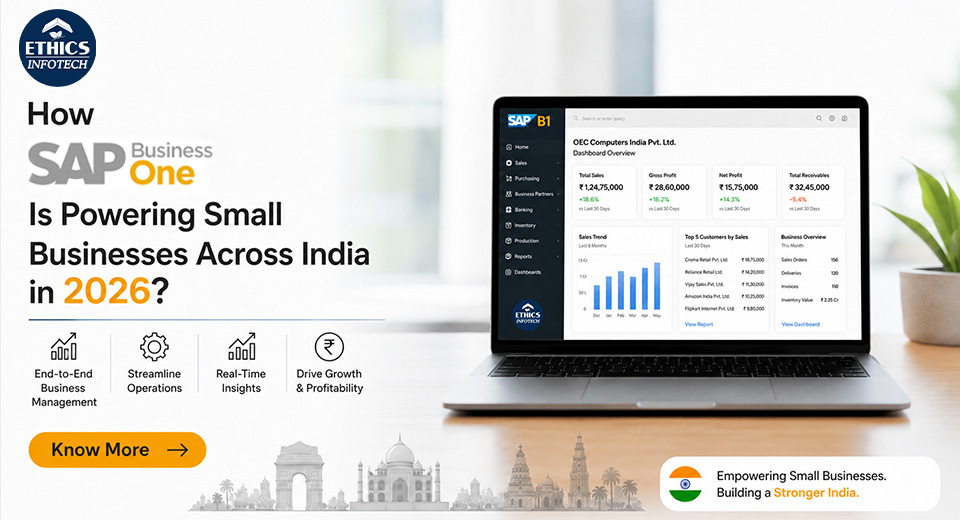
That’s where SAP Business One plays a key role. It offers a single, unified solution that brings all departments together. From purchasing to accounting and from warehouse tracking to customer management, everything runs on one dashboard.
This not only saves time but also eliminates errors that often occur when data is handled manually. Most importantly, it gives small employers real-time insights to make informed decisions.
A Closer Look at SAP Business One Modules
This ERP software is designed to scale with your business. It’s made up of multiple apps, each focusing on a specific area. Here’s how its modules ensure growth:
Finance and Accounting
Handles invoices, payments, expenses, and financial reports. Owners can easily track profits, cash flow, and budgets in one place.
Sales and CRM
Helps manage leads, customer information, and sales pipelines. Teams can follow up faster and close deals more efficiently.
Inventory and Warehouse Management
Tracks stock levels in real time and automates reorder alerts. This is especially useful for small manufacturers, distributors, and retailers.
Purchasing and Procurement
Simplifies supplier management and purchase orders, reducing delays and overstocking.
Production and Planning
For small manufacturers, this module improves scheduling, resource allocation, and order tracking.
Human Resources (HR)
Manages employee records, payroll, attendance, and appraisals, keeping all HR data organized. Each module works seamlessly with others, which means small firms can start with what they need and add more as they grow.
The Power of SAP Business One Cloud
In 2026, many Indian businesses are choosing the SAP Business One cloud model instead of conventional on-premises systems. The cloud version allows users to access their ERP system from anywhere, whether it’s a laptop, tablet, or phone.
Cloud deployment also reduces the need for heavy IT infrastructure and maintenance costs. Updates happen automatically, ensuring the system stays secure and up to date. It is a perfect fit for startups and small companies that want flexibility and lower setup costs.
Imagine a business owner in Mumbai checking daily sales while traveling or a warehouse manager in Delhi updating stock on a tablet; that’s the power of the cloud version. It’s faster, lighter, and ideal for the modern Indian SME.
Real Benefits for Indian SMEs
Small businesses in India face unique challenges, tight budgets, changing tax regulations, and the need to scale quickly. SAP addresses these pain points directly.
Here are a few ways it helps:
-
Simplifies compliance: Keeps up with GST and Indian accounting standards.
-
Improves efficiency: Reduces paperwork and manual data entry.
-
Boosts customer experience: Real-time insights help serve customers better.
-
Saves time and money: Automates repetitive tasks and minimizes errors.
-
Scales easily: Add new users or modules as your company grows.
For many Indian SMEs, SAP isn’t just software; it’s a complete business partner that streamlines operations and supports growth.
Why 2026 Is the Right Time to Invest
The Indian business environment is changing rapidly. Customers expect faster deliveries, accurate information, and seamless service. Government policies are pushing for digital compliance and automation.
In such a scenario, relying on disconnected tools can limit your potential. Businesses that have adopted SAP Business One India are seeing improvements in productivity, data accuracy, and profit margins.
With affordable cloud plans, simplified user interfaces, and strong local support, SAP has made enterprise-level technology accessible to small businesses like never before.
Is SAP Business One Right for You?
If you’re a small or mid-sized company looking for better control over your operations, the answer is likely yes. But before you decide, consider a few points:
-
Are your teams wasting time on manual reporting or data entry?
-
Do you lack real-time visibility into your sales or inventory?
-
Are errors and delays affecting customer satisfaction?
If these sound familiar, SAP for small businesses in India can help. Start with a few core modules, see the difference, and expand as your needs grow.
Final Thoughts
In 2026, Indian SMEs are no longer competing just locally; they're competing globally. To stay ahead, they need tools that simplify, connect, and empower. SAP Business One does exactly that.
From managing finances and sales to improving customer service and decision-making, it helps small businesses work smarter. No matter whether you choose on-premises or SAP Business One cloud, the benefits remain the same; you will achieve control, visibility, and growth.
So, if you’re ready to take your business to the next level, SAP Business One India could be the foundation you need to build a stronger, more efficient future.